Benavenuto a casa, nero D'avola
When you think about Italian wine grapes, the mind turns to warm afternoons sipping Chianti in Tuscany or glasses of chilled Pinot Grigio in the foothills of the Italian Alps. You don’t think inky dark Nero d’Avola in Oregon’s Columbia Gorge.
Until now, that is.
Around 2020, when Capital Call Vintners co-founders Dr. Alan Busacca and Steve and Nikki Bruere were establishing their partnership, dormant vines of Nero d’Avola became available. Coming from Sicilian heritage, Alan was curious how this Italian grape would fare in Oregon and what the resulting wine would be like.
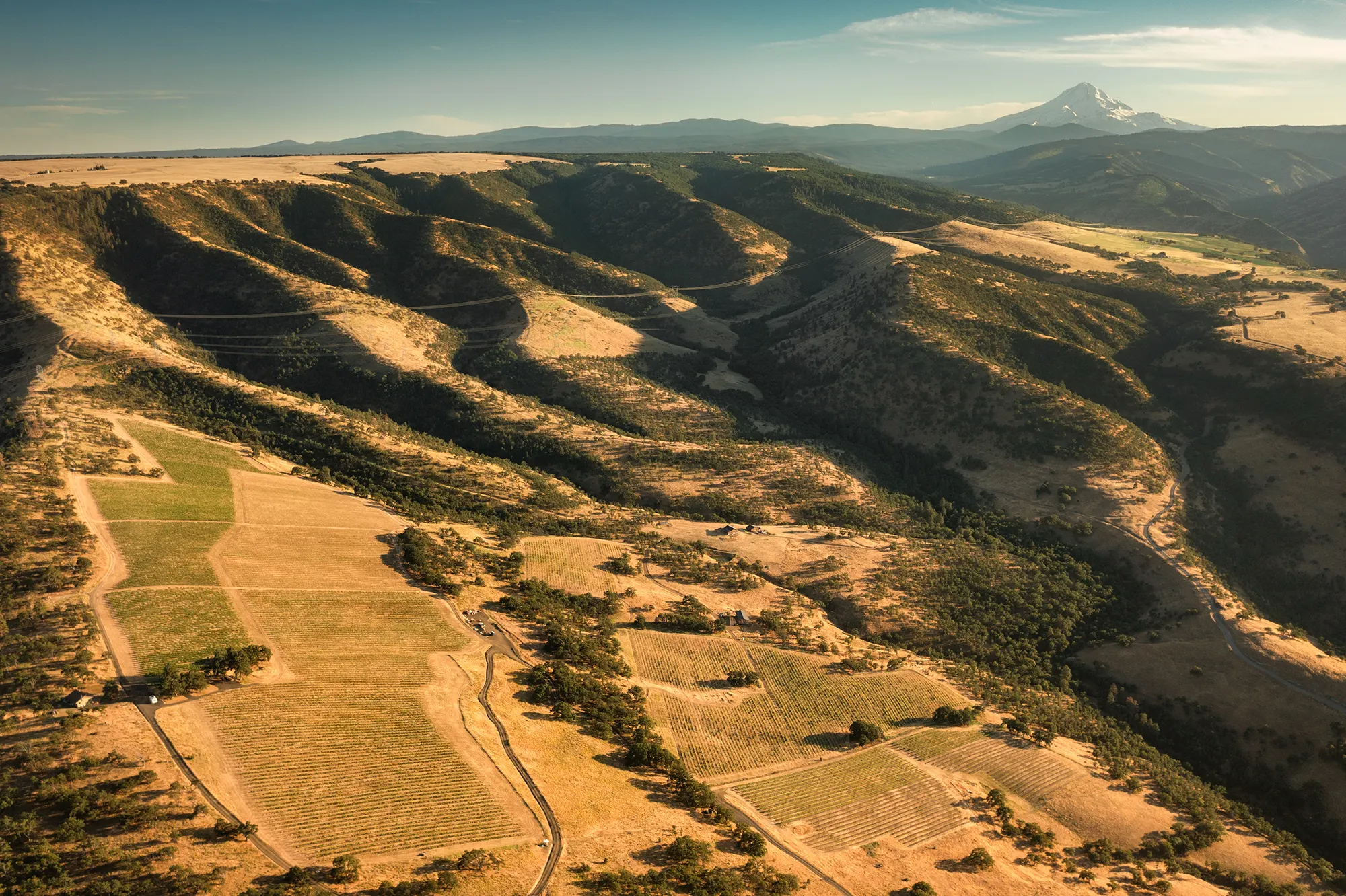
After consulting with vineyard manager Nick Mackay of Results Partners, the partners planted two and a half acres at their estate Windhorse Vineyard in 2021 in honor of Alan’s Italian heritage and grandfather.
In 1906, Alan’s grandfather immigrated to the United States from Sicily, following a couple of his sisters who had settled near Lake Michigan in Wisconsin (Grandpa Busacca was one of nine children). While Alan has made his home in the Pacific Northwest, he has visited his ancestral homeland and his scores of cousins several times over past decades. It was on one of these family trips about 25 years ago that Alan first tasted Nero d’Avola.
“I fell in love with the history of wine in Sicily,” said Alan, adding that he is planning to visit again this year.
BRINGING NERO D’AVOLA TO THE PACIFIC NORTHWEST
Nero d’Avola has been grown in Sicily for at least 2,000 years. It’s rumored that the Greeks originally brought the grape to the island. It’s only in the last decade that Nero has become available to the U.S. market and Windhorse is one of the very few vineyards growing this Italian variety on the west coast.
To ensure cuttings are not diseased and that the rootstock is healthy, the USDA holds the Nero cuttings in quarantine. The cuttings undergo complex lab and field procedures to ensure viral, fungal, and bacterial pathogens have been eradicated from the parent vinestock. When deemed healthy, they are made available to commercial grapevine nurseries for sale. The nurseries then typically graft cuttings of the vines for increased disease resistance and grow them for a year. Once they have grown sturdy enough, the cuttings are uprooted, cleaned, carefully wrapped, put in cold storage, and shipped to their new home. Windhorse Vineyard was one of those new homes.
THE GEOLOGICAL SIMILARITIES OF WINDHORSE TO SOUTHERN SICILY
ICYMI, Alan is a soil scientist and geologist, and taught at Washington State University for 25 years so when you ask him a question such as “How is this Italian grape fairing in the Columbia Gorge?” you get a very thorough answer from the aptly nicknamed “Dr. Dirt”: “How the dry and warm parts of the Columbia Gorge affect the wine is still to be seen. In Southeastern Sicily, the soils are dominantly formed from marine limestone. Since limestone is mainly calcium carbonate, the soil root environment of the vines is rich in calcium.
At Windhorse, there is a moisture deficit. Most the moisture in the soil is used by the plants over the growing season, leaving little to no moisture draining into the groundwater. This leaves the alkali elements, including calcium as soil-formed calcium carbonate, in the soil. We have a semi-arid climate in the Gorge which allows calcium to build up in the soil as calcium carbonate or lime and creates lime-rich subsoils. This is not equivalent to the limestone soils of Sicily; however, it has a similar impact. Both regions have calcium rich environments.
Also, both regions share the impact of volcanic parent materials in soil: in Sicily from Mt. Etna and in the Mill Creek Valley hillside location of Windhorse Vineyard, from the soft volcanic sandstone that forms the parent material of the soils.” (Did you get all that? Don’t worry—Dr. Dirt said no pop quizzes today.)
OUR FIRST NERO VINTAGE AND FUTURE PRODUCTIVITY
When the first vintage of Nero d’Avola was in barrel and samples shared with clients and partners, the response was hugely positive. In 2024, 2.75 additional acres of Nero were planted at Windhorse bringing the total acreage to almost six acres.
The 2023 vintage is the first available commercially (it’s on the website and in the tasting room now!). The 2024 vintage is currently in barrel for an anticipated 2026 release and, also in 2026, the newest plantings will produce their first crop.
“We’re making the Nero in a straightforward way,” said Alan. “We’re using neutral oak and letting the varietal characteristics shine through.”
This past May, Alan shared barrel samples of the ’23 Nero d’Avola at Soča, a wine shop in nearby White Salmon. Two guests came up to him separately after he spoke, one who currently works in wine distribution and one who formerly worked in distribution. Both were excited and impressed that the Windhorse Nero d’Avola was “varietally correct” and of a quality you would find in Sicily.
“It was so exciting!” said Alan. “The Nero is so pleasing. It’s rich, flavorful, and has great length without being heavy.”
Nero d’Avola isn’t the only Italian grape planted at Windhorse Vineyard. There are also 6.5 acres of Sangiovese, best known as Chianti in Tuscany, and five acres of Primitivo, originally grown in Puglia. In 2027, the partners plan to plant Vermentino, a white grape originating in Sardinia that is gaining recognition in the states. It will be first Italian white variety to join the familia at Windhorse Vineyard and the Capital Call Vintners portfolio of wines.